
The website builder market is noisier than ever. Every platform has a polished homepage, a compelling demo video, and a pricing page that looks reasonable until you actually sign up and discover what “unlimited” means in the fine print. I’ve been through enough of these to know which ones hold up in real use and which ones disappoint the moment a project gets slightly complicated.
This list reflects 15 years of building sites for clients and myself – across business types, budgets, and technical comfort levels. These five platforms earned their spots through performance, not marketing.
How I Rank Website Builders
Rather than a generic checklist, here’s what actually determined the order:
| Criterion | What I’m Really Testing |
| Editor usability | Time from blank page to something credible |
| Template quality | Do they look like real websites or builder templates? |
| Business-readiness | Can it handle the features a real business actually needs? |
| SEO foundation | What’s the organic traffic ceiling on this platform? |
| True cost | Intro rate vs. year-two renewal vs. what you’ll actually pay |
| Longevity | Will this platform still make sense in three years? |
Ready to get your site live once you’ve chosen? The Build Your First Website guide covers every step.
1 – Duda
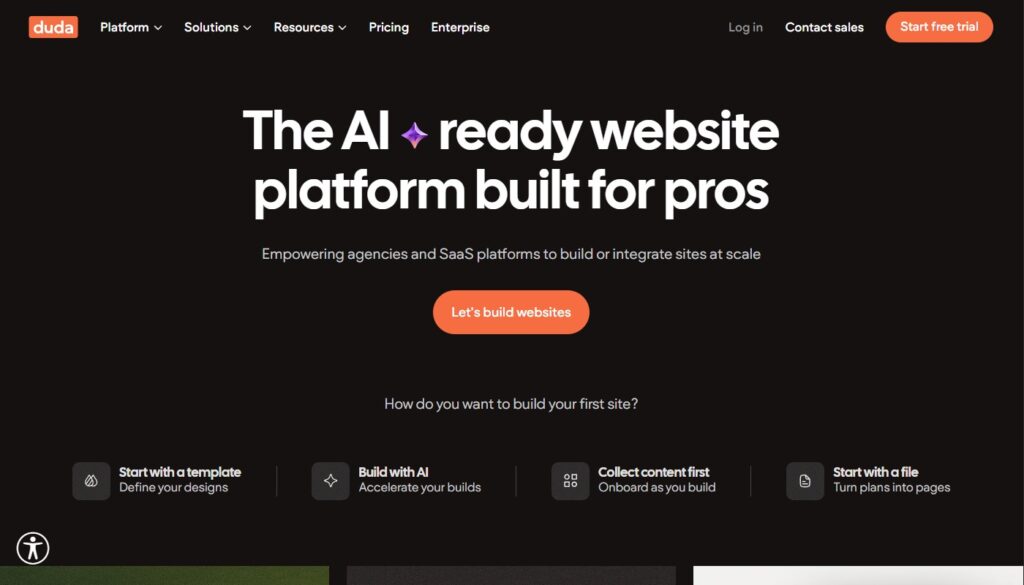
Best for professional results. Best platform for agencies and serious business sites.
Duda is the least-known platform on this list outside of professional web circles, and that’s precisely why it leads. While consumer-facing builders compete for beginner attention, Duda has focused on building the best platform for web professionals – agencies, freelancers, and business owners who need a result that looks genuinely custom without writing custom code.
The editor is structured but flexible – more opinionated than Wix’s free-form canvas (read my Wix review), which means it’s harder to accidentally produce something that looks amateur. Every template is built on a clean design system with consistent spacing, typography, and color logic. The outcome is a level of visual coherence that drag-and-drop platforms rarely achieve.
Duda’s standout feature for business use is its built-in personalization engine: you can show different content to visitors based on location, device, time of day, or traffic source. This is a genuinely advanced capability included in the standard platform – not a premium add-on. For service businesses wanting to speak differently to local audiences or mobile visitors, it’s a meaningful differentiator.
Team collaboration tools, client management features, white-label options, and a native widget builder round out a platform that takes professional website work seriously.
- Price: From $19/mo (Basic); $29/mo (Team); $59/mo (Agency)
- Best for: Agencies, freelancers, serious small business owners who want professional-grade output
- Pros: Superior visual consistency, personalization engine, excellent team/client tools, white-label options
- Cons: Pricier than most builders; smaller app marketplace than Wix; less consumer brand recognition
If you’re building a Duda site and want to add lead qualification tools, the Top 5 Form & Calculator Tools covers the best options – several embed cleanly into Duda pages.
2 – Shopify
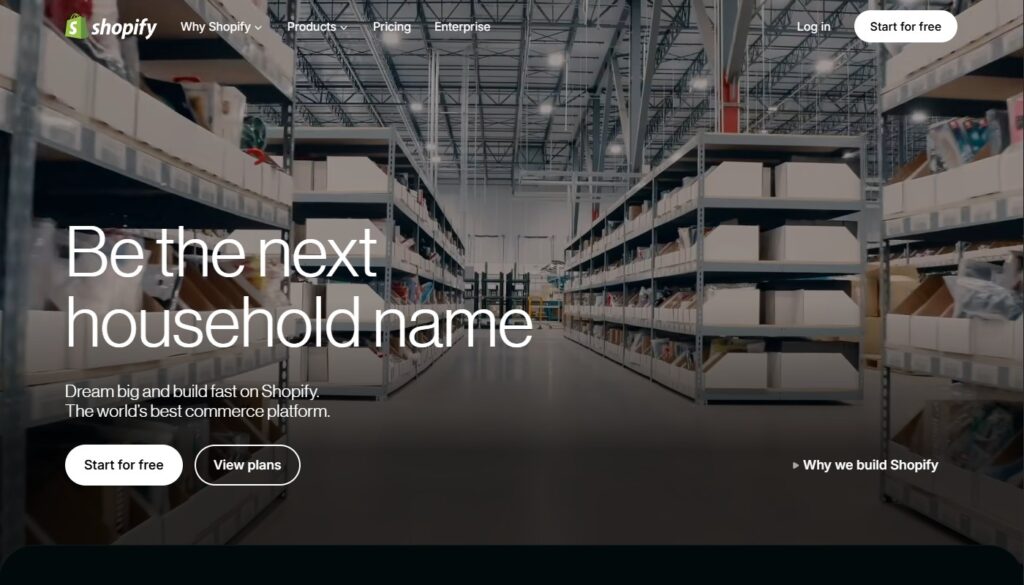
Best for online stores. The only builder where e-commerce is genuinely first-class.
Shopify is included here specifically for anyone whose website is primarily a sales channel. Every other platform on this list – including the otherwise capable Duda – treats e-commerce as a feature bolted onto a website builder. Shopify treats it as the product. The difference is significant.
Inventory management, multi-currency pricing, shipping rate calculations, abandoned cart recovery, product variant logic, wholesale pricing, subscription products, POS integration – Shopify handles all of it cleanly, at scale, without workarounds. The app store adds 8,000+ extensions for virtually every retail use case.
Shopify’s blogging and content tools are functional but not exceptional – for pure content sites, other platforms on this list are better choices. For stores, nothing else competes.
- Price: From $39/mo (Basic); $105/mo (Shopify); $399/mo (Advanced)
- Best for: Online stores of any size, product-based businesses, brands needing serious e-commerce
- Pros: Best-in-class e-commerce, enormous app ecosystem, excellent POS, scales to enterprise
- Cons: Not cost-effective for non-e-commerce sites; transaction fees if not using Shopify Payments; overkill for simple stores
3 – uKit
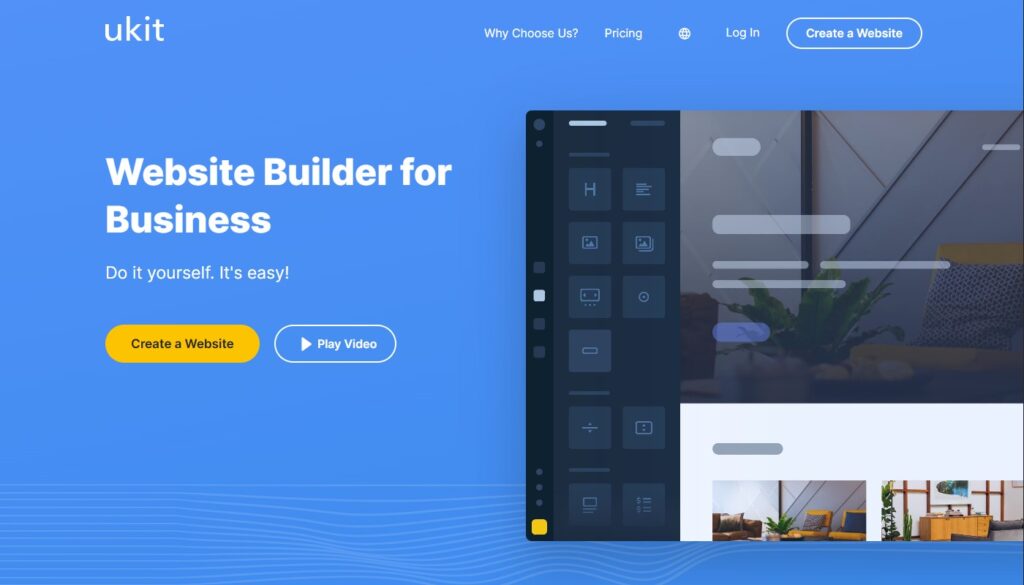
Best value. Best-suited for service businesses. Consistently underrated.
uKit holds the third spot because it solves a specific and very common problem better than any other platform: a local or regional service business needs a professional, credible website with working lead-capture tools and doesn’t want to spend $40/month or manage a WordPress installation to get it.
The templates are specifically designed around service business patterns – prominent contact sections, service listings, testimonial blocks, and clear calls to action baked into the layout. You’re not adapting a generic design to a business context; you’re starting from a business context and customizing it. That distinction produces better results faster for non-designers.
The widget library covers everything a service business needs without requiring third-party apps: contact forms, booking tools, image galleries, social feeds, and map integrations are all standard. The editor is clean and fast. And the pricing – starting well below what most competing platforms charge – means the value-to-cost ratio is genuinely difficult to match.
I recommend uKit to clients who’ve been quoted $400+ to set up a basic WordPress site and don’t understand why they’d need to pay that much. They usually don’t.
- Price: From $4/mo – the most affordable capable builder available
- Best for: Local businesses, service providers, consultants, tradespeople, freelancers
- Pros: Outstanding value, purpose-built business templates, full widget suite included, fast setup
- Cons: Smaller template variety than larger platforms; less international market recognition
4 – GoDaddy Website Builder
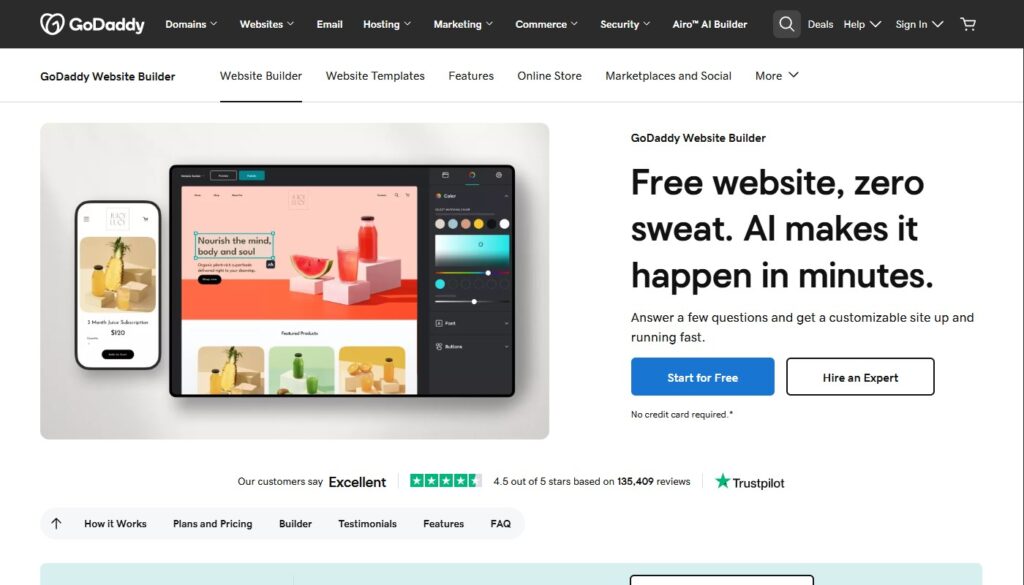
Best for fastest time to live. Genuinely the quickest path from zero to published.
GoDaddy’s website builder doesn’t get fair coverage in most reviews because it’s not exciting. It doesn’t have Duda’s design sophistication or Shopify’s e-commerce depth. What it has is an AI-assisted setup process that can put a functional, mobile-responsive business website live in under an hour – including the domain and hosting – with no prior experience required.
The AI starter asks about your business type, location, and goals, then generates a complete site with copy placeholder suggestions and a relevant layout. You edit what needs editing, connect your domain (often already registered with GoDaddy), and publish. For a local business that needs to be findable online and doesn’t want to invest days in website setup, GoDaddy’s builder is honest about what it is and delivers it efficiently.
The ceiling is lower than other platforms on this list. If you have design requirements or need anything beyond a clean, standard business presence, you’ll feel the limitations. But “clean and published” beats “in-progress and perfect” for most small local businesses.
- Price: From $9.99/mo
- Best for: Local businesses, sole traders, anyone who needs a site live fast with minimal friction
- Pros: Fastest setup of any builder, AI-assisted content, deeply integrated with GoDaddy domain/hosting, simple pricing
- Cons: Low design ceiling; limited customization; not suitable for content-heavy or complex sites
5 – Strikingly
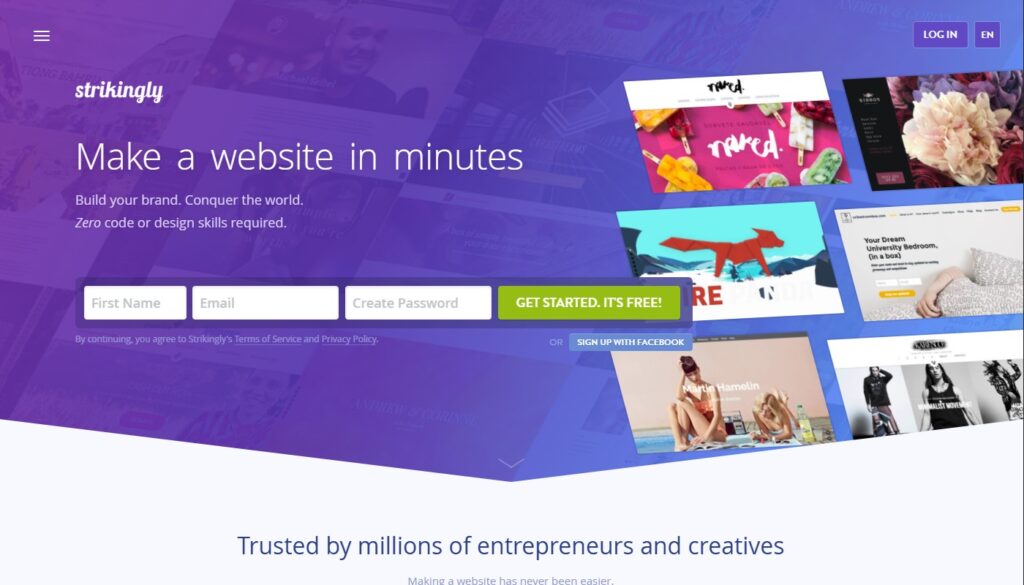
Best for single-page sites and personal brands. Underused and underpriced.
Strikingly occupies a distinct niche: single-page websites. Rather than building a traditional multi-page site, Strikingly creates long-scroll pages with distinct sections – about, services, portfolio, contact – that visitors navigate by scrolling or using anchor links. It’s an increasingly popular format for personal brands, freelancers, and businesses that don’t need dozens of pages.
The builder is clean, the templates are genuinely stylish, and the free plan is the most functional in its category. Setup is faster than any multi-page builder. For a consultant, speaker, musician, or creative professional who needs a polished single-destination online presence, Strikingly delivers it at a price point that’s hard to argue with.
It’s not the right tool for complex sites, blogs, or stores. But for its intended use case, it’s excellent.
- Price: Free plan available; paid from $8/mo
- Best for: Personal brands, freelancers, speakers, creatives, simple portfolio sites
- Pros: Fastest single-page builder, clean mobile-first templates, generous free plan, low learning curve
- Cons: Single-page format only; not suitable for multi-page businesses or content sites
Which Builder Fits Your Situation?
| Your Situation | Best Pick |
| Agency or professional output needed | Duda |
| Selling products online | Shopify |
| Service business on a budget | uKit |
| Local business, need live fast | GoDaddy |
| Freelancer or personal brand | Strikingly |
🔗 Don’t miss: 5 Web Hosting Services That Actually Deliver – if you choose self-hosted WordPress as an alternative, your host matters enormously