
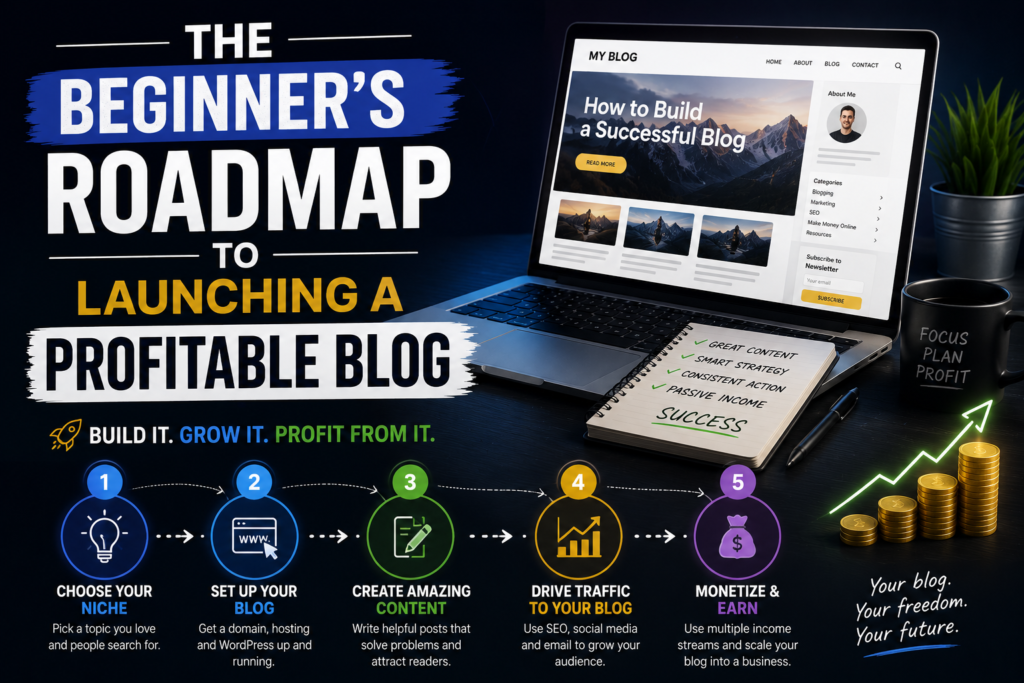
Let me tell you the thing most blogging guides won’t: most blogs fail. Not because blogging doesn’t work as a business model – it does, demonstrably, for thousands of people – but because most new bloggers approach it like a hobby and then wonder why it doesn’t perform like a business.
This roadmap is for people who want to do it right. Not overnight, not without effort, but with a clear framework and realistic expectations. I’ve been running blogs and consulting for content businesses since 2009. What follows is how I’d approach building a new blog from scratch with everything I’ve learned.
The technical steps for getting your actual site live are in the Build Your First Website guide. This roadmap is about strategy, monetization, and what actually drives long-term results.
Stage 1: Choose a Niche You Can Own
Not just any niche – a niche where you can become the best resource on the internet.
The standard advice is “choose something you’re passionate about.” That’s necessary but not sufficient. Passion without search demand produces content nobody finds. Search demand without expertise produces content that doesn’t rank because it’s indistinguishable from the thousand other thin articles on the same topic.
The niche sweet spot has three properties:
You have real knowledge or genuine curiosity. You’ll be writing hundreds of thousands of words on this topic over the next few years. Fake enthusiasm runs out fast.
People are actively searching for this information. Use a keyword tool to verify demand before committing. 5 SEO Tools I Actually Use covers the tools that will tell you this – several have free tiers that are sufficient for niche validation.
Monetization exists. Someone in this space is selling something – software, courses, physical products, services. Where there’s commercial activity, there’s affiliate income and advertising revenue.
Niches with consistently strong monetization
Personal finance, web and software tools, health and fitness, home improvement, business and marketing, travel, parenting, legal and financial services, education and learning.
This doesn’t mean only these niches work. It means these niches have proven affiliate programs, strong CPMs, and established buyer intent. Any focused niche can work – but these are the ones where the economics are clearest.
Stage 2: Platform and Hosting Decisions
Self-hosted WordPress is the right long-term choice for most serious blogs. You own your content, you have access to 50,000+ plugins, and the SEO ceiling is higher than any hosted platform. The trade-off is setup complexity and ongoing maintenance.
Hosted platforms (Wix, uKit, Squarespace) are legitimate alternatives for bloggers who want to focus entirely on content without managing a CMS. They’re simpler, lower maintenance, and surprisingly capable. Top 5 Website Builders Worth Your Money covers all the options with honest pros and cons.
For self-hosted WordPress, your hosting choice matters more than most people realize. A slow host creates a performance gap that’s hard to overcome with optimization alone. See the Best Web Hosting Services guide before deciding.
Stage 3: Build Your Content Architecture Before You Write
This is the step most beginners skip, and it’s responsible for more failed blogs than any other single factor.
Random publishing – writing about whatever seems interesting this week – produces a site with no topical coherence. Google can’t figure out what the site is about. Neither can readers. Neither, increasingly, can you.
The alternative is a topic cluster architecture:
- Identify 3–5 broad pillar topics within your niche
- For each pillar, map 8–12 specific long-tail keywords (the cluster articles)
- Publish the cluster articles first, then the pillar posts
- Interlink cluster articles to their pillar and to each other
This structure tells Google clearly what your site covers. It builds topical authority faster than scattered publishing. And it gives you a content calendar that removes the “what should I write this week” decision entirely.
Example from a digital marketing blog:
- Pillar: “Best SEO Tools”
- Clusters: “How to use Ahrefs for keyword research,” “Surfer SEO review,” “Google Search Console setup guide,” “Ubersuggest vs Ahrefs comparison”
Stage 4: Write Content That Deserves to Rank
Long-form doesn’t mean padded. The goal is comprehensive coverage of a topic at a depth that genuinely serves the reader – not hitting a word count target for its own sake.
For every article, before you write a single word, answer these four questions:
What is the reader actually trying to accomplish? Not just “what is the keyword” – what’s the underlying job they’re trying to do?
What would the best possible answer look like? Look at the top 5 results for your target keyword. Where are the gaps? What’s missing? What could you cover more thoroughly?
What’s the right structure? Headers, subheadings, tables, bullet lists, embedded tools, comparison charts – use whatever format helps the reader get the answer fastest.
What’s the next logical thing they need? Internal linking isn’t just an SEO tactic – it’s serving the reader’s natural next question.
Stage 5: Build the Audience Infrastructure
The best content in the world is worth nothing if you have no system to capture the audience it builds.
Email list, from day one. Set up your email platform before your first post goes live. Create a simple lead magnet – a checklist, template, resource list, or short guide – and offer it in exchange for an email address. The subscribers you collect in months 1–3 are typically your most engaged long-term readers.
The Top 5 Online Marketing Tools guide covers the right email platforms for different stages of growth.
Survey your audience early. Within the first six months, run a reader survey. What questions do they have? What would they pay for? What do they wish you’d written about? The answers shape your next 50 articles.
SurveyNinja makes this fast and easy – it’s the tool I recommend for this specific use case.
Stage 6: Monetization Strategy
Here’s the honest sequencing:
Months 1–6: Focus entirely on traffic and list building. No monetization pressure. Revenue at this stage is a distraction.
Months 6–12: Add affiliate links to any existing content that references tools or products. Apply to Google AdSense once you have consistent traffic.
Year 2+: The real monetization begins. Affiliate income compounds. AdSense RPMs improve with authority. Digital products become viable. Sponsored content becomes appealing to brands.
The five monetization channels, in order of complexity
| Channel | When to Start | Income Ceiling |
| Display ads (AdSense) | 1,000+ monthly visitors | Moderate (scales with traffic) |
| Affiliate marketing | Any time | High (top earner for most blogs) |
| Sponsored content | When you have an engaged audience | High |
| Digital products | Year 2 | Very high (margin-rich) |
| Services/consulting | Any time | Immediate, but time-limited |
Realistic Expectations
I’m not going to tell you this is easy or fast. Here’s what I’ve seen across bloggers I’ve followed, worked with, and mentored:
6 months in: Most people have 20–30 published posts, a small but growing email list, and essentially no revenue. This is normal.
12 months in: Bloggers who’ve executed consistently – publishing regularly, building links, collecting emails – are typically seeing $300–$1,500/mo. Bloggers who published sporadically are wondering why it’s not working.
24 months in: The ceiling opens up significantly. Blogs with strong topical authority and consistent traffic can reasonably hit $5,000–$15,000/mo across multiple revenue channels.
The difference between the blogs that get there and the ones that don’t is almost never talent. It’s consistency, patience, and treating this like a real business from the start.